Initiatives
Our Social Contribution Initiatives

Senior Centers / Day Care Centers / Adult Care CenterSenior Centers: Books and Knowledge for Later Life
Access to books should not have an age limit.
People continue to ask questions, discover new subjects, revisit old interests, and seek meaningful connections throughout life.
That is why Senior Centers are one of our seven planned social contribution directions.
Our goal is to help create environments where books, ideas, and knowledge remain accessible during later stages of life.
Why Senior Centers Matter
Senior centers are important community spaces.
They bring people together for activities, conversation, services, and social connection.
They can also become places for continued intellectual engagement.
Later life may create more time for subjects that were difficult to explore during earlier stages filled with work and family responsibilities.
Books can offer access to history, science, mathematics, culture, technology, society, nature, and many other areas that remain meaningful regardless of age.
Intellectual Activity Continues Throughout Life
A common mistake is to think of education as something that belongs mainly to childhood and young adulthood.
Human interest does not end with graduation or retirement.
People continue to think, compare, remember, question, and discover.
A senior may want to understand a new technology.
Another may return to a subject first encountered decades earlier.
Someone else may become interested in nature, mathematics, history, health, or culture for the first time.
Books make those possibilities available.
Books Can Support Social Connection
Reading does not have to be solitary.
A shared book can create conversation.
A reading group can bring people together around a common subject.
One person's experience can add another dimension to what is written on the page.
Senior communities contain decades of accumulated knowledge and experience. Books can become catalysts that help those experiences move between people.
In this sense, a reading space can support both intellectual and social connection.
Creating Welcoming Spaces for Reading
Physical accessibility matters.
A reading space for seniors should be comfortable, visible, and easy to use.
Clear organization, suitable seating, appropriate lighting, and accessible book placement can make a significant difference in whether a collection becomes part of everyday life.
The objective is not simply to donate books.
It is to create conditions in which those books can actually be opened, shared, and revisited.
Connecting Generations Through Knowledge
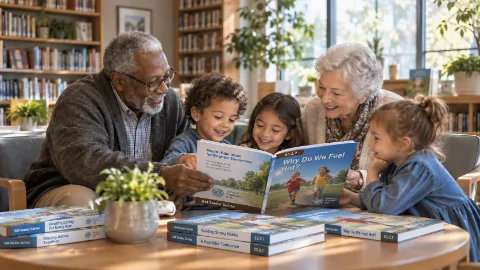
Senior centers also create opportunities for intergenerational connection.
Older adults carry experiences that younger generations do not yet have.
Books can provide common subjects around which those experiences are shared.
A story about history may lead to personal memories.
A book about science or technology may create a conversation about how the world has changed.
A mathematics or nature book may give grandparents and grandchildren something new to explore together.
Knowledge can therefore move in both directions.
Books bring new ideas into the center, while seniors bring lived experience to those ideas.
Senior Centers Within the Seven Directions
Within our seven social contribution directions, Senior Centers represent later life.
Postpartum care centers stand near the beginning of family life.
Daycare centers represent early childhood.
Schools and colleges support the years when formal knowledge expands.
Military bases represent another important transition.
Senior centers help complete the life-stage structure.
The principle remains the same from beginning to later life:
People should continue to have opportunities to encounter books and knowledge.
Later life is not outside that principle.
It is an essential part of it.Blue Ribbon SchoolsSchools / Blue Ribbon Schools: Expanding Access During the School Years
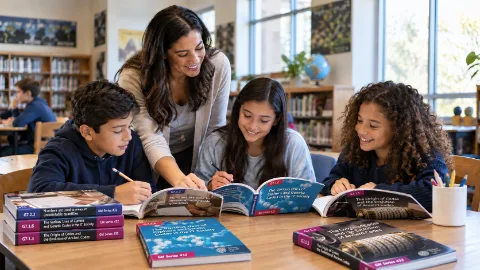
The school years are a period of rapid expansion.
Children encounter more subjects, more complex questions, and more structured forms of knowledge. Mathematics becomes broader. Science becomes more detailed. History expands the dimensions of time and society. Technology introduces new possibilities.
During this stage, access to strong books and educational resources matters.
That is why Schools / Blue Ribbon Schools form the third direction of our planned social contribution initiatives.
Why Schools Matter
Schools are where knowledge becomes increasingly systematic.
Children move from basic encounters toward deeper understanding. They compare, represent, analyze, connect, and apply what they know in more sophisticated ways.
Books can strengthen that environment by providing paths beyond the immediate lesson.
A classroom has limited time.
A textbook has limited space.
A teacher cannot anticipate every question.
Additional books can create more possibilities.
Mathematics as a Way to Understand the World
Our contribution to Schools / Blue Ribbon Schools places particular emphasis on mathematics books.
But the purpose is not simply to provide more exercises.
Mathematics connects naturally with the world around us.
Patterns appear in nature. Measurement helps describe physical reality. Numbers express relationships. Probability helps reason about possibilities. Statistics helps interpret data. Functions describe change.
Mathematics also connects with science, technology, engineering, humanity, and society.
A strong collection of mathematics books can therefore help students see mathematics not only as a school subject, but as a way of interpreting relationships within the world.
Supporting Students and Teachers Together
School resources rarely benefit only one group.
Students gain additional ways to explore a concept.
Teachers gain additional examples, explanations, visual materials, and subject connections.
Books may support classroom discussions, independent exploration, projects, clubs, libraries, or conversations that begin from a student's question.
This creates a multiplier effect.
One donated collection can be encountered by many students and used by many teachers over time.
Why Blue Ribbon Schools Are Included
Our planned school initiatives include Blue Ribbon Schools because social contribution does not need to operate through only one type of educational environment.
Different schools provide different opportunities to understand how books can be used, shared, and integrated into real educational settings.
Strong school communities can provide useful environments for observing which subjects attract attention, which materials teachers choose to use, and how books connect with existing programs and classroom activities.
The goal is not to define one school model as the only destination for support.
The goal is to create meaningful relationships with schools in different environments and understand how educational resources can generate the greatest value.
Beyond the Number of Books Donated
The easiest number to report is how many books were delivered.
That number matters, but it is not enough.
A more meaningful question is what happens after the books arrive.
Are they opened?
Which books are repeatedly used?
Do students ask new questions?
Do teachers find them useful?
Do they connect mathematics with nature, science, technology, or other subjects?
Do they create additional conversations inside or outside the classroom?
As these initiatives develop, those questions should matter alongside the quantity of donated resources.
Schools as Community Access Points
Schools occupy a special position within communities.
They connect students, teachers, families, administrators, and local institutions.
Because of this, access created within a school can extend beyond a single reader.
A student encounters an idea at school and discusses it at home.
A teacher introduces a book to an entire class.
A school library allows the same resource to be encountered repeatedly over many years.
The social value of a school contribution can therefore extend beyond the original donation.
A Critical Stage in the Seven Directions
Within our seven social contribution directions, Schools / Blue Ribbon Schools represent the school years.
Postpartum care centers begin near the start of family life.
Daycare centers create access during early childhood.
Schools then become the environment in which knowledge grows broader, more structured, and increasingly connected.
Later stages will continue through higher education, military service, senior communities, and international partnerships.
Each stage has a different role.
For schools, the role is clear:
Put high-quality books and knowledge within reach during the years when students are actively building a broader understanding of the world.
Books should not simply fill shelves.
They should create possibilities.Liberal Arts CollegesLiberal Arts Colleges: Connecting Mathematics with a Wider World of Knowledge
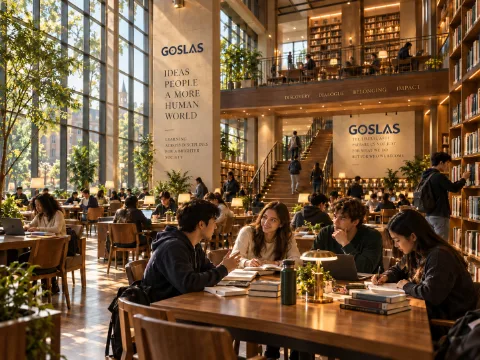
Higher education is a stage when knowledge begins to cross boundaries more deliberately.
Students move beyond individual subjects and begin asking how different fields relate to one another. Mathematics may connect with physics, economics, biology, philosophy, technology, design, history, or society.
That is why Liberal Arts Colleges are one of our seven planned social contribution directions.
Our objective is to provide access to mathematics books that encourage broader intellectual connections and help position mathematics within a wider understanding of the world.
Why Liberal Arts Colleges Matter
A liberal arts environment is built around connection.
Students encounter different disciplines, perspectives, methods, and questions. They are encouraged not only to know more, but to understand how one field may illuminate another.
Mathematics has an important place in that environment.
It provides ways to represent relationships, analyze patterns, interpret change, and reason about what cannot always be directly observed.
When mathematics books connect those ideas with nature, science, technology, humanity, and society, mathematics can become part of a much broader intellectual conversation.
Mathematics Beyond a Single Department
Mathematics does not belong only inside a mathematics classroom.
A student studying biology may encounter growth, structure, probability, or data.
A student studying economics may encounter relationships, functions, change, and statistics.
A student studying architecture may encounter geometry, measurement, structure, and proportion.
A student studying philosophy may ask questions about logic, representation, evidence, and prediction.
Providing mathematics books across liberal arts environments can help make those connections more visible.
Supporting Broader Intellectual Exploration
A donated collection can become useful in many different ways.
A student may discover a book outside their major.
A professor may use an example to connect mathematics with another subject.
A library may create a thematic collection linking mathematics with science, culture, history, or technology.
A conversation that begins with one discipline may move into another.
This is one reason Liberal Arts Colleges can become meaningful environments for mathematics books designed around relationships rather than isolated exercises.
Strengthening the Role of the Library
College libraries are more than storage spaces.
They are places where different disciplines coexist.
That makes them especially suitable for collections designed to cross subject boundaries.
A mathematics book placed in this environment can be encountered not only by mathematics students, but by students in the humanities, sciences, social sciences, arts, and professional fields.
One collection can therefore reach many different intellectual communities.
From Specialization to Connection
Higher education naturally produces specialization.
Specialization is necessary, but important ideas often emerge when people are able to connect what they know with something outside their immediate field.
Books can support that process by creating unexpected encounters.
A mathematical pattern may lead to architecture.
A structure in nature may connect to engineering.
A historical development may reveal the mathematics behind a technological change.
The value is not simply more information.
It is more connection.
Liberal Arts Colleges Within the Seven Directions
Within our seven social contribution directions, Liberal Arts Colleges represent young adulthood and higher education.
This stage follows the school years, when knowledge becomes increasingly structured, and enters a period when individuals begin making deeper choices about what they want to study and how different fields may relate.
Our contribution at this stage is therefore not simply about providing more books.
It is about helping mathematics remain connected to the wider world of knowledge.
Because higher education should not narrow the world.
It should make the relationships within it more visible.UNICEF - International ConnectionsUNICEF - International Connections: Extending Access Beyond Borders
Access to books and knowledge is not distributed equally across the world.
Geography, infrastructure, language, economic conditions, and differences in local resources can all affect whether educational materials reach the people and communities that may benefit from them.
That is why International Connections form the seventh direction of our social contribution initiatives.
While our first six directions follow different stages and environments of life, International Connections add another dimension: geography.
As part of this direction, we plan to work with UNICEF on future initiatives that can help extend access to books, educational content, and knowledge beyond individual institutions and national borders.
Why International Connections Matter
Knowledge can move far beyond the place where it was first created.
A book developed in one country can introduce an idea to a child in another. Mathematics observed through nature can be understood across cultures. Educational content can create connections between people who may live in very different environments but share the same desire to understand the world.
But meaningful international contribution requires more than sending books from one country to another.
Different communities have different languages, infrastructures, priorities, and educational environments. What is useful in one location may need to be adapted before it can create the same value somewhere else.
This is why international contribution must be built through collaboration.
Working with UNICEF
A central part of our future international social contribution direction will be collaboration with UNICEF.
UNICEF's international reach and experience working with children and communities can provide an important pathway for identifying where resources may be meaningful and how they can be delivered within appropriate local contexts.
Our role is centered on what we can contribute: books, mathematics content, educational resources, and the knowledge structure we have developed through our publishing activities.
Through future work with UNICEF, we hope to explore how these resources can reach communities where additional access to books and educational content can create meaningful opportunities.
The goal is not simply to place our materials in more countries.
The goal is to work with an organization that already understands local needs and use that connection to make contribution more relevant, practical, and sustainable.
Beyond Shipping Books
International contribution should not be measured only by the number of physical books sent overseas.
Different communities may require different forms of access.
In one region, printed books and library collections may be appropriate. In another, digital content may reach more people. Some environments may benefit from materials for teachers or community organizations. Others may require translated or locally adapted resources.
The form can change according to the environment.
What should remain consistent is the objective:
Make useful books and knowledge more accessible to the people who can benefit from them.
Working with UNICEF and other international partners can help us understand which form of contribution is most appropriate in each setting.
Local Context Comes First
Educational content does not exist separately from language, culture, community, and environment.
A book that works well in one country may require translation elsewhere. An example familiar to one group of children may be unfamiliar to another. Infrastructure may determine whether printed or digital access is more practical.
Responsible international contribution therefore begins with listening.
What does the community need?
Who will use the materials?
Which ages are being served?
What languages are required?
Where will the books or content remain accessible?
Who will support their continued use?
Working through established international and local networks can help answer these questions before resources are distributed.
This makes contribution more than a one-time delivery.
It allows access to become part of a continuing structure.
Books Can Connect Communities
Books carry knowledge, but they can also create connections.
A child may encounter a natural phenomenon that exists on another continent.
A student may discover that the same mathematical relationship appears in architecture, plants, movement, or technology across different cultures.
A teacher may encounter a different way of explaining an idea.
A community may gain access to materials that were previously difficult to obtain.
At the same time, international contribution is not only about knowledge moving outward from us.
Working with communities in different regions can also expand our own understanding of how people encounter mathematics, books, and educational content in different environments.
Knowledge can move in both directions.
From Life Stages to a Global Reach
The first six directions of our social contribution strategy follow people through different stages and environments of life:
Postpartum Care Centers — the beginning of family life
Daycare Centers — early childhood
Schools / Blue Ribbon Schools — the school years
Liberal Arts Colleges — higher education
Military Bases — military service
Senior Centers — later life
International Connections extend that structure beyond geography.
The principle that connects all seven directions remains the same:
Books and knowledge should be more accessible at different stages of life and in different communities.
Through future collaboration with UNICEF, that principle can begin to extend beyond the communities closest to us and into a broader international context.
Across ages.
Across institutions.
Across communities.
Across borders.
Building Contribution That Can Continue
The value of an international initiative should not be measured simply by how many countries appear on a map or how many books are distributed in a single event.
Meaningful contribution requires continuity.
As our work with UNICEF and other international partners develops, we intend to look at how resources are provided, where they remain available, which communities they reach, and how future initiatives can be improved.
Some projects may begin with books.
Others may develop into reading spaces, digital access, educational resources, or new forms of collaboration.
The important point is that each initiative should create a foundation for something that can continue.
A Wider Meaning for Access
Our social contribution begins with access.
At a postpartum care center, that means placing books near a family at the beginning of life together.
At a daycare center, it means creating early encounters with ideas.
At a school, it means expanding access during the years when knowledge grows broader.
At a senior center, it means ensuring that intellectual activity continues into later life.
And through International Connections, including our planned work with UNICEF, it means asking how the same principle can reach people beyond local and national boundaries.
The geography becomes larger.
The purpose does not change.
Bring books closer.
Share knowledge more widely.
Create more opportunities for people to encounter the world through ideas.
That is the role of International Connections within our seven social contribution directions.March 2026Postpartum Care Centers: Books at the Beginning of Family LifePostpartum Care Centers: Books at the Beginning of Family Life
Postpartum care centers represent one of the earliest environments a new family experiences together.
A child has just entered the world. Parents are recovering, adjusting to new responsibilities, and beginning to think differently about health, family, childhood, and the future.
For that reason, Postpartum Care Centers are an important starting point in our planned social contribution initiatives.
Our objective is simple: bring books and knowledge closer to families at the beginning of family life.
Why Postpartum Care Centers Matter
The period following childbirth is unlike almost any other stage of life.
Daily routines change. Priorities change. Questions that once felt distant suddenly become personal.
Parents begin thinking about the environment their child will grow up in, the experiences they will encounter, and the kinds of ideas that may eventually shape their understanding of the world.
Books can have a quiet but meaningful place in this period.
Not as a formal program. Not as another responsibility. And not as an attempt to begin structured education earlier.
Simply as something valuable that is present and within reach.
Books Without Pressure
A postpartum care center is primarily a place of recovery and care.
Any contribution to that environment should respect its purpose.
A parent may open a book for only a few minutes. Another may browse through photographs or illustrations. Someone may encounter a subject that leads to a conversation with a spouse or becomes something they want to explore again later.
There is nothing to complete.
The value is in creating the opportunity to encounter knowledge naturally.
A visible bookshelf, a thoughtfully selected collection, or a small reading area can become part of the environment without demanding anything from the people using it.
Creating an Environment Where Books Are Present
Access to knowledge depends on more than whether information technically exists somewhere.
Environment matters.
When books are visible and accessible, people encounter subjects they may never have deliberately searched for. A title catches someone's attention. An image raises a question. One subject leads to another.
That is why our planned contribution to Postpartum Care Centers can go beyond individual book donations.
Where appropriate, it can include small reading areas, dedicated bookshelves, and collections designed for parents and families during this particular stage of life.
The space does not have to be large to have meaning.
It simply has to make books part of the environment.
Two Generations at the Same Time
The immediate reader may be the parent, but the environment belongs to the family.
When books are naturally present from the beginning, they can become ordinary objects within family life rather than something introduced only when a child enters school.
Parents may discover books they later want at home. A subject encountered during postpartum care may be revisited years later with the child. A habit of keeping books nearby may continue long after the family leaves the center.
In this way, one contribution can touch two generations at once.
More Than a Book Donation
The value of this initiative is not measured only by the number of books placed in a center.
The broader value comes from what those books make possible.
For parents, they create moments of reflection and discovery.
For families, they can help establish an environment in which books are familiar from the beginning.
For postpartum care centers, they can add another dimension to a space already dedicated to supporting new families.
And for society, they help extend access to books into a stage of life that is rarely considered when educational resources are distributed.
The First Stage of a Longer Journey
Postpartum Care Centers are the first point in a broader life-stage approach to social contribution.
The journey can continue through daycare centers, schools, colleges, military communities, senior centers, and international partnerships.
The locations change, but the principle remains consistent:
Books and knowledge should remain within reach as people move through life.
Postpartum care centers are meaningful because they are close to the beginning of that journey.
A new child.
A new family.
A new stage of life.
And a meaningful place for books to be present from the start.
Standards Documentation Released Without ChargeComing Soon
Open public sessions run at no chargeComing Soon
Classroom use of Math Letters permitted without licence or feeComing Soon
Books placed with public librariesComing Soon
Continue reading
A book reaches one reader. A space reaches a community. Care keeps both going.
Explore SustainabilityNext in ESGExplore Sustainability