
Blue Ribbon Schools
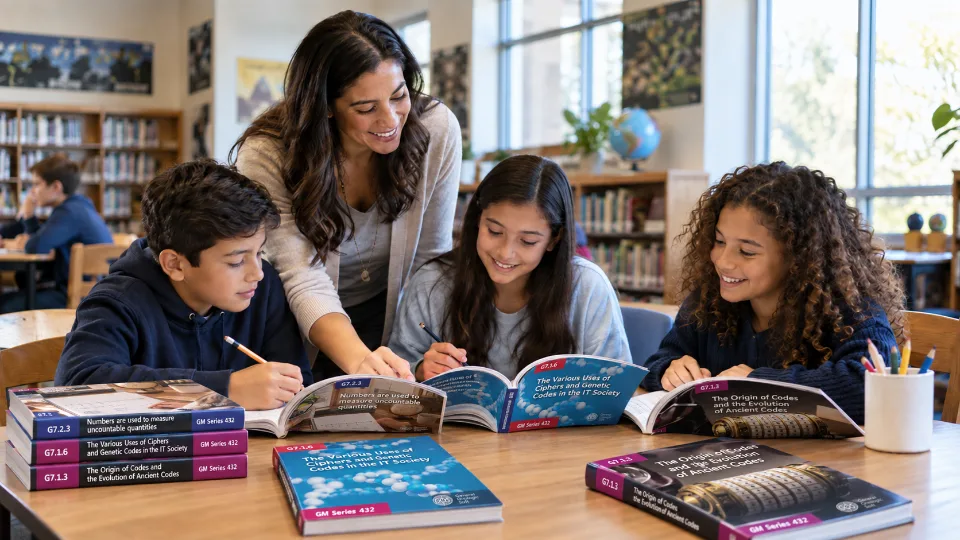
Schools / Blue Ribbon Schools: Expanding Access During the School Years
The school years are a period of rapid expansion.
Children encounter more subjects, more complex questions, and more structured forms of knowledge. Mathematics becomes broader. Science becomes more detailed. History expands the dimensions of time and society. Technology introduces new possibilities.
During this stage, access to strong books and educational resources matters.
That is why Schools / Blue Ribbon Schools form the third direction of our planned social contribution initiatives.
Why Schools Matter
Schools are where knowledge becomes increasingly systematic.
Children move from basic encounters toward deeper understanding. They compare, represent, analyze, connect, and apply what they know in more sophisticated ways.
Books can strengthen that environment by providing paths beyond the immediate lesson.
A classroom has limited time.
A textbook has limited space.
A teacher cannot anticipate every question.
Additional books can create more possibilities.
Mathematics as a Way to Understand the World
Our contribution to Schools / Blue Ribbon Schools places particular emphasis on mathematics books.
But the purpose is not simply to provide more exercises.
Mathematics connects naturally with the world around us.
Patterns appear in nature. Measurement helps describe physical reality. Numbers express relationships. Probability helps reason about possibilities. Statistics helps interpret data. Functions describe change.
Mathematics also connects with science, technology, engineering, humanity, and society.
A strong collection of mathematics books can therefore help students see mathematics not only as a school subject, but as a way of interpreting relationships within the world.
Supporting Students and Teachers Together
School resources rarely benefit only one group.
Students gain additional ways to explore a concept.
Teachers gain additional examples, explanations, visual materials, and subject connections.
Books may support classroom discussions, independent exploration, projects, clubs, libraries, or conversations that begin from a student's question.
This creates a multiplier effect.
One donated collection can be encountered by many students and used by many teachers over time.
Why Blue Ribbon Schools Are Included
Our planned school initiatives include Blue Ribbon Schools because social contribution does not need to operate through only one type of educational environment.
Different schools provide different opportunities to understand how books can be used, shared, and integrated into real educational settings.
Strong school communities can provide useful environments for observing which subjects attract attention, which materials teachers choose to use, and how books connect with existing programs and classroom activities.
The goal is not to define one school model as the only destination for support.
The goal is to create meaningful relationships with schools in different environments and understand how educational resources can generate the greatest value.
Beyond the Number of Books Donated
The easiest number to report is how many books were delivered.
That number matters, but it is not enough.
A more meaningful question is what happens after the books arrive.
Are they opened?
Which books are repeatedly used?
Do students ask new questions?
Do teachers find them useful?
Do they connect mathematics with nature, science, technology, or other subjects?
Do they create additional conversations inside or outside the classroom?
As these initiatives develop, those questions should matter alongside the quantity of donated resources.
Schools as Community Access Points
Schools occupy a special position within communities.
They connect students, teachers, families, administrators, and local institutions.
Because of this, access created within a school can extend beyond a single reader.
A student encounters an idea at school and discusses it at home.
A teacher introduces a book to an entire class.
A school library allows the same resource to be encountered repeatedly over many years.
The social value of a school contribution can therefore extend beyond the original donation.
A Critical Stage in the Seven Directions
Within our seven social contribution directions, Schools / Blue Ribbon Schools represent the school years.
Postpartum care centers begin near the start of family life.
Daycare centers create access during early childhood.
Schools then become the environment in which knowledge grows broader, more structured, and increasingly connected.
Later stages will continue through higher education, military service, senior communities, and international partnerships.
Each stage has a different role.
For schools, the role is clear:
Put high-quality books and knowledge within reach during the years when students are actively building a broader understanding of the world.
Books should not simply fill shelves.
They should create possibilities.