
Liberal Arts Colleges
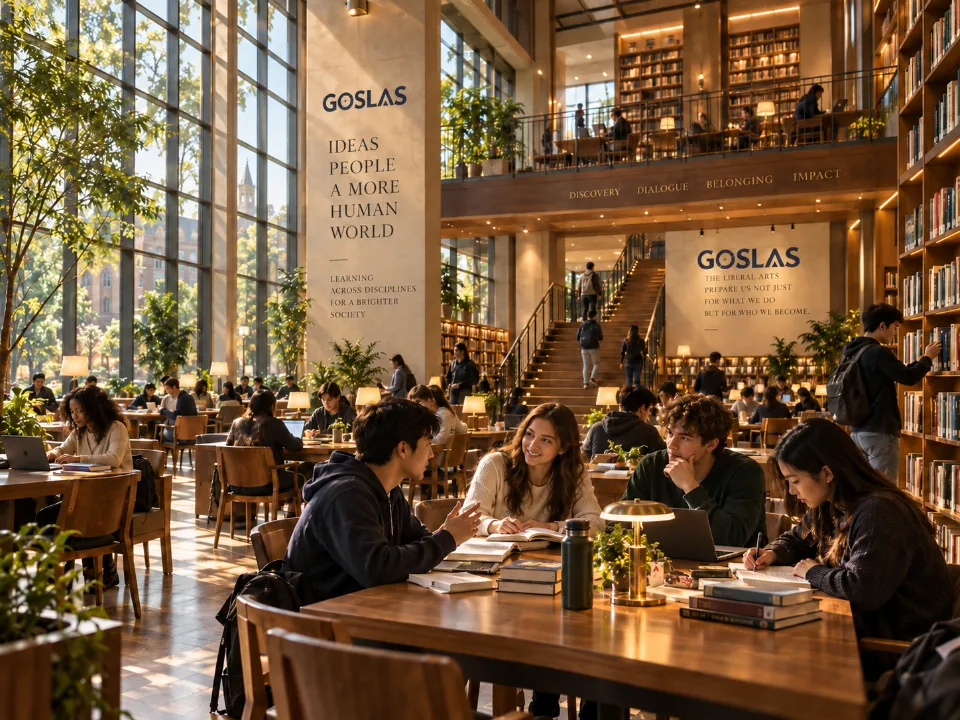
Liberal Arts Colleges: Connecting Mathematics with a Wider World of Knowledge
Higher education is a stage when knowledge begins to cross boundaries more deliberately.
Students move beyond individual subjects and begin asking how different fields relate to one another. Mathematics may connect with physics, economics, biology, philosophy, technology, design, history, or society.
That is why Liberal Arts Colleges are one of our seven planned social contribution directions.
Our objective is to provide access to mathematics books that encourage broader intellectual connections and help position mathematics within a wider understanding of the world.
Why Liberal Arts Colleges Matter
A liberal arts environment is built around connection.
Students encounter different disciplines, perspectives, methods, and questions. They are encouraged not only to know more, but to understand how one field may illuminate another.
Mathematics has an important place in that environment.
It provides ways to represent relationships, analyze patterns, interpret change, and reason about what cannot always be directly observed.
When mathematics books connect those ideas with nature, science, technology, humanity, and society, mathematics can become part of a much broader intellectual conversation.
Mathematics Beyond a Single Department
Mathematics does not belong only inside a mathematics classroom.
A student studying biology may encounter growth, structure, probability, or data.
A student studying economics may encounter relationships, functions, change, and statistics.
A student studying architecture may encounter geometry, measurement, structure, and proportion.
A student studying philosophy may ask questions about logic, representation, evidence, and prediction.
Providing mathematics books across liberal arts environments can help make those connections more visible.
Supporting Broader Intellectual Exploration
A donated collection can become useful in many different ways.
A student may discover a book outside their major.
A professor may use an example to connect mathematics with another subject.
A library may create a thematic collection linking mathematics with science, culture, history, or technology.
A conversation that begins with one discipline may move into another.
This is one reason Liberal Arts Colleges can become meaningful environments for mathematics books designed around relationships rather than isolated exercises.
Strengthening the Role of the Library
College libraries are more than storage spaces.
They are places where different disciplines coexist.
That makes them especially suitable for collections designed to cross subject boundaries.
A mathematics book placed in this environment can be encountered not only by mathematics students, but by students in the humanities, sciences, social sciences, arts, and professional fields.
One collection can therefore reach many different intellectual communities.
From Specialization to Connection
Higher education naturally produces specialization.
Specialization is necessary, but important ideas often emerge when people are able to connect what they know with something outside their immediate field.
Books can support that process by creating unexpected encounters.
A mathematical pattern may lead to architecture.
A structure in nature may connect to engineering.
A historical development may reveal the mathematics behind a technological change.
The value is not simply more information.
It is more connection.
Liberal Arts Colleges Within the Seven Directions
Within our seven social contribution directions, Liberal Arts Colleges represent young adulthood and higher education.
This stage follows the school years, when knowledge becomes increasingly structured, and enters a period when individuals begin making deeper choices about what they want to study and how different fields may relate.
Our contribution at this stage is therefore not simply about providing more books.
It is about helping mathematics remain connected to the wider world of knowledge.
Because higher education should not narrow the world.
It should make the relationships within it more visible.