
UNICEF - International Connections
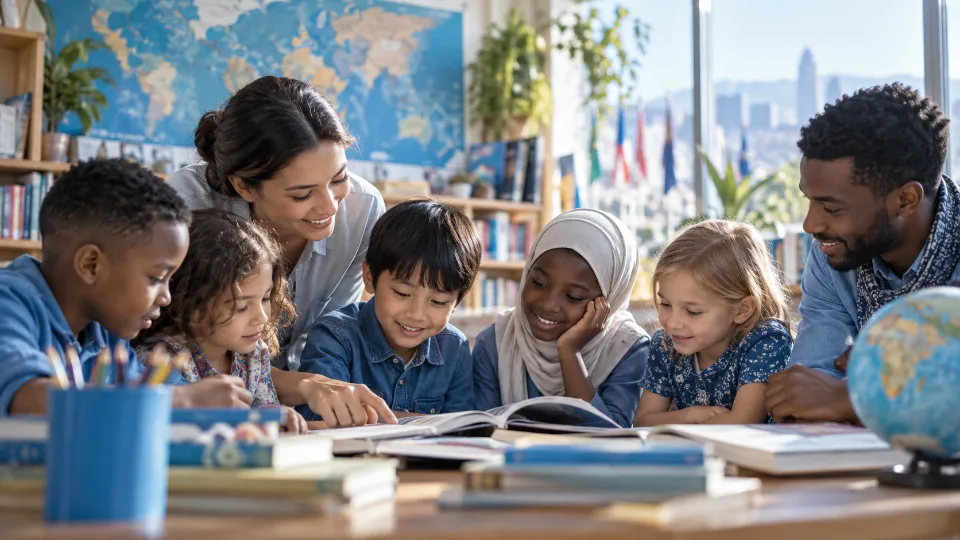
UNICEF - International Connections: Extending Access Beyond Borders
Access to books and knowledge is not distributed equally across the world.
Geography, infrastructure, language, economic conditions, and differences in local resources can all affect whether educational materials reach the people and communities that may benefit from them.
That is why International Connections form the seventh direction of our social contribution initiatives.
While our first six directions follow different stages and environments of life, International Connections add another dimension: geography.
As part of this direction, we plan to work with UNICEF on future initiatives that can help extend access to books, educational content, and knowledge beyond individual institutions and national borders.
Why International Connections Matter
Knowledge can move far beyond the place where it was first created.
A book developed in one country can introduce an idea to a child in another. Mathematics observed through nature can be understood across cultures. Educational content can create connections between people who may live in very different environments but share the same desire to understand the world.
But meaningful international contribution requires more than sending books from one country to another.
Different communities have different languages, infrastructures, priorities, and educational environments. What is useful in one location may need to be adapted before it can create the same value somewhere else.
This is why international contribution must be built through collaboration.
Working with UNICEF
A central part of our future international social contribution direction will be collaboration with UNICEF.
UNICEF's international reach and experience working with children and communities can provide an important pathway for identifying where resources may be meaningful and how they can be delivered within appropriate local contexts.
Our role is centered on what we can contribute: books, mathematics content, educational resources, and the knowledge structure we have developed through our publishing activities.
Through future work with UNICEF, we hope to explore how these resources can reach communities where additional access to books and educational content can create meaningful opportunities.
The goal is not simply to place our materials in more countries.
The goal is to work with an organization that already understands local needs and use that connection to make contribution more relevant, practical, and sustainable.
Beyond Shipping Books
International contribution should not be measured only by the number of physical books sent overseas.
Different communities may require different forms of access.
In one region, printed books and library collections may be appropriate. In another, digital content may reach more people. Some environments may benefit from materials for teachers or community organizations. Others may require translated or locally adapted resources.
The form can change according to the environment.
What should remain consistent is the objective:
Make useful books and knowledge more accessible to the people who can benefit from them.
Working with UNICEF and other international partners can help us understand which form of contribution is most appropriate in each setting.
Local Context Comes First
Educational content does not exist separately from language, culture, community, and environment.
A book that works well in one country may require translation elsewhere. An example familiar to one group of children may be unfamiliar to another. Infrastructure may determine whether printed or digital access is more practical.
Responsible international contribution therefore begins with listening.
What does the community need?
Who will use the materials?
Which ages are being served?
What languages are required?
Where will the books or content remain accessible?
Who will support their continued use?
Working through established international and local networks can help answer these questions before resources are distributed.
This makes contribution more than a one-time delivery.
It allows access to become part of a continuing structure.
Books Can Connect Communities
Books carry knowledge, but they can also create connections.
A child may encounter a natural phenomenon that exists on another continent.
A student may discover that the same mathematical relationship appears in architecture, plants, movement, or technology across different cultures.
A teacher may encounter a different way of explaining an idea.
A community may gain access to materials that were previously difficult to obtain.
At the same time, international contribution is not only about knowledge moving outward from us.
Working with communities in different regions can also expand our own understanding of how people encounter mathematics, books, and educational content in different environments.
Knowledge can move in both directions.
From Life Stages to a Global Reach
The first six directions of our social contribution strategy follow people through different stages and environments of life:
Postpartum Care Centers — the beginning of family life
Daycare Centers — early childhood
Schools / Blue Ribbon Schools — the school years
Liberal Arts Colleges — higher education
Military Bases — military service
Senior Centers — later life
International Connections extend that structure beyond geography.
The principle that connects all seven directions remains the same:
Books and knowledge should be more accessible at different stages of life and in different communities.
Through future collaboration with UNICEF, that principle can begin to extend beyond the communities closest to us and into a broader international context.
Across ages.
Across institutions.
Across communities.
Across borders.
Building Contribution That Can Continue
The value of an international initiative should not be measured simply by how many countries appear on a map or how many books are distributed in a single event.
Meaningful contribution requires continuity.
As our work with UNICEF and other international partners develops, we intend to look at how resources are provided, where they remain available, which communities they reach, and how future initiatives can be improved.
Some projects may begin with books.
Others may develop into reading spaces, digital access, educational resources, or new forms of collaboration.
The important point is that each initiative should create a foundation for something that can continue.
A Wider Meaning for Access
Our social contribution begins with access.
At a postpartum care center, that means placing books near a family at the beginning of life together.
At a daycare center, it means creating early encounters with ideas.
At a school, it means expanding access during the years when knowledge grows broader.
At a senior center, it means ensuring that intellectual activity continues into later life.
And through International Connections, including our planned work with UNICEF, it means asking how the same principle can reach people beyond local and national boundaries.
The geography becomes larger.
The purpose does not change.
Bring books closer.
Share knowledge more widely.
Create more opportunities for people to encounter the world through ideas.
That is the role of International Connections within our seven social contribution directions.